Who has the right of way when kitesurfing?
Avoid kite collisions
To prevent accidents and collisions in the kite area, there are simple right-of-way rules that every kitesurfer must know. Just like in road traffic, kitesurfing has rules that determine which kiter has the right of way and must maintain their course, and which kiter must give way. If you’re learning to kitesurf, this is an important part of your theoretical training and is also part of the kitesurfing license exam.
Rules for Safe Kiting
The purpose of the right-of-way rules is to provide every kitesurfer with simple guidelines to ensure that no one is put in danger. Every participant on the water must behave in a manner that ensures the safety and smooth flow of traffic and that no one else is harmed, endangered, or inconvenienced.
Kitesurfing Safety Rules
International priority rules
When kitesurfing, in addition to the rules developed specifically for kitesurfing (e.g., by the IKO and VDWS), the International Rules of the Road always apply on any body of water. The International Rules of the Road also apply on German inland waters:
✔︎ Commercial vessels always have the right of way.
✔︎ After commercial vessels come sailing craft, which have the right of way over recreational boats (motorboats or sailboats powered by a motor); these, in turn, have the right of way over recreational equipment. In this case, kitesurfers are considered sailing craft.
✔︎ Within the group of sailing craft, kitesurfers must give way to sailboats, as sailboats are slower and cannot maneuver nearly as quickly as a kitesurfer.
✔︎ Muscle power takes precedence over sail power: swimmers, surfers, bodyboarders, SUP paddlers, canoeists, etc., always have the right of way.
On the German coast, kitesurfers are considered “sports equipment” and are therefore at the top of the list when it comes to the duty to yield.
So on the German coast, you must yield to everyone.
Which kitesurfer has the right of way?
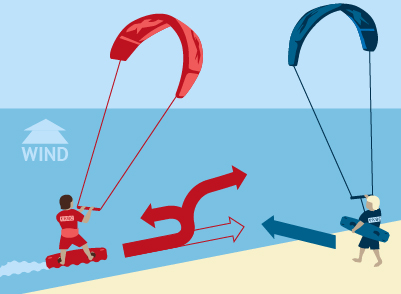
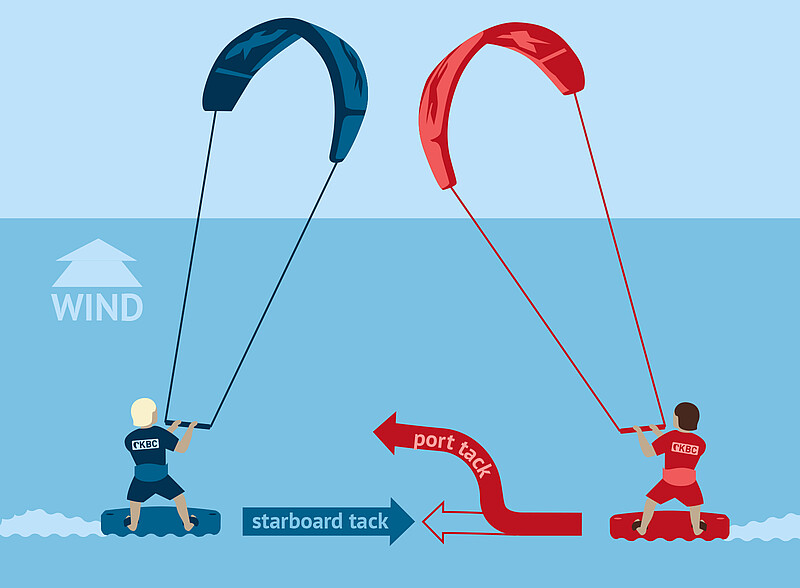
The kitesurfer downwind has the right of way over the kiter upwind. If two kitesurfers with different jibes meet, the one with the wind on their starboard side (right) has the right of way. Kitesurfers launching or landing, as well as those with the kite at the zenith, also have the right of way.
What do windward and leeward mean in kitesurfing?
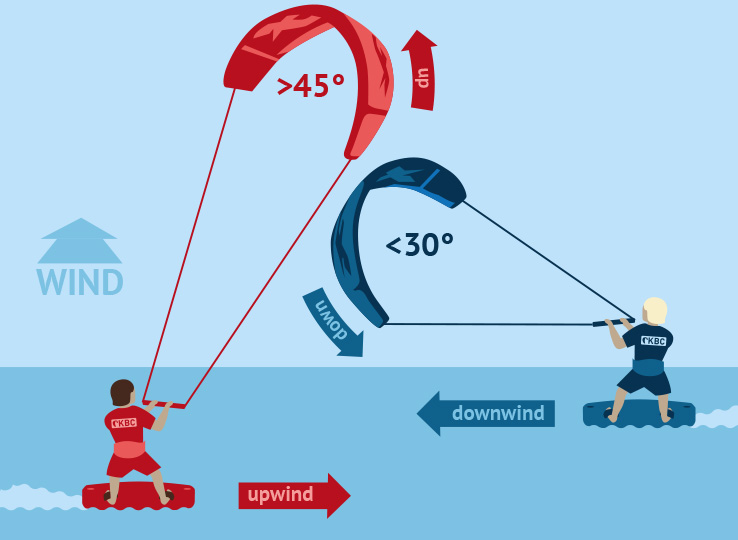
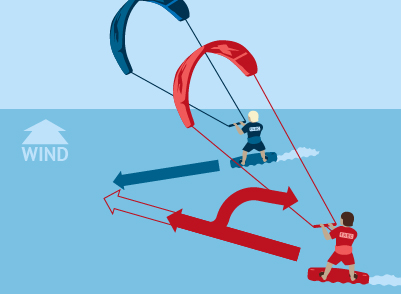
Windward is the side facing the wind; leeward is the side away from the wind. In kitesurfing, this means: The kiter on the windward side rides higher upwind, while the kiter on the leeward side rides lower downwind. When two kitesurfers meet, the kiter on the windward side must give way, while the kiter on the leeward side maintains their course.
How wide should the safety distance be when kitesurfing?
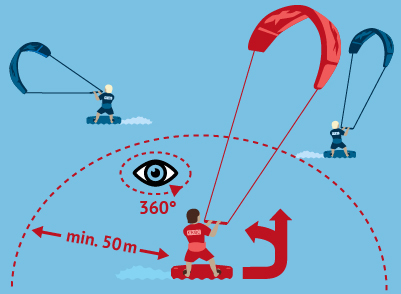
For jumps, tricks, and direction changes, a minimum distance of 50 meters (i.e., twice the length of the kite lines) must be maintained from other water sports enthusiasts and obstacles. Riding is not permitted in the launch and landing zones. When passing another rider, a generous safety distance is mandatory.
What does the Code RED rule mean in kitesurfing?
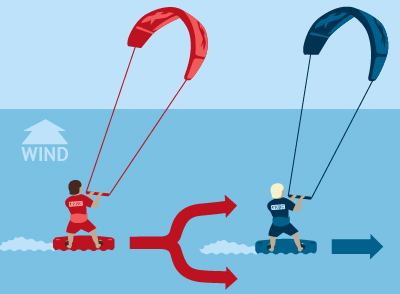
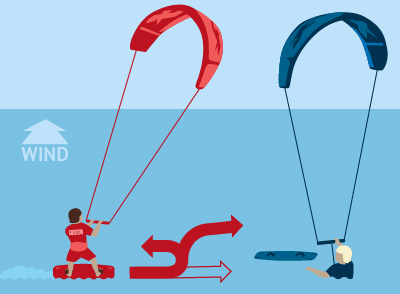
Code RED stands for “Early, Decisive, Distinct.” Anyone planning a maneuver, a jump, or a change of direction must act early, clearly decide on a direction, and execute the maneuver in a clearly visible manner—always maintaining a distance of at least 50 meters from other kitesurfers.
Do the rules of right-of-way also apply along the German coast?
On the German coast, kitesurfers are legally classified as “sports equipment” and are therefore required to yield to other water users. This means that commercial vessels, sailboats, motorboats, rowboats, windsurfers, SUPs, and swimmers have the right of way. Among kitesurfers, the international right-of-way rules of the VDWS and IKO also apply.
Who must give way when two kitesurfers are on a collision course?
If both kitesurfers are on the same jibe, the kiter on the windward side must give way and fly their kite high at an angle of over 45°. The kiter on the leeward side maintains course and flies their kite low at an angle of less than 30°. If the kites are on different jibes, the kiter with the wind on their port side (left) must give way to the kiter with the wind on their starboard side (right).
Are the right-of-way rules part of the VDWS or IKO license exam?
Yes. In both the VDWS Basic Kitesurfing License Exam and the IKO Level Exam, the right-of-way rules are a mandatory part of the theory section. Without a solid understanding of windward and leeward, port and starboard, as well as the rules in the launch and landing zones, you will not pass the exam.
What should you do if the other kiter doesn’t know the right-of-way rules for kiting?
Safety always takes precedence over right of way. Even if you actually have the right of way, you should give way if the other kiter is clearly misjudging the situation or not reacting. Ride defensively, maintain eye contact, and always plan a possible escape route.
Here's how to behave when you encounter someone on the water
A safe encounter with other kitesurfers almost always follows the same sequence. These four steps will help you reliably avoid collisions—no matter where you’re kitesurfing.
Step 1: Spot them early
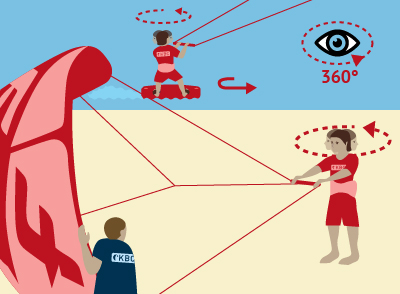
Always maintain a 360° view of your surroundings. Spot other kitesurfers as early as possible—ideally before you’re less than 100 meters apart.
Step 2: Check your jibe and position
Is the wind coming from starboard or port? Are you to windward or leeward? This automatically determines who has the right of way and who must give way.
Step 3: Apply Code RED
React in a timely manner, clearly choose a direction, and make your maneuver clearly visible—for example, by positioning your kite distinctly (high above 45° or low below 30°).
Step 4: Keep your distance
Even after the encounter, the rule applies: Keep a distance of at least 50 meters before initiating a jump or a new maneuver.
Right-of-way rules in practice – common situations
You're riding on a half-wind course and a kiter is coming toward you
Check which side the wind is coming from for both of you. If the wind is coming from port (left), you must give way and fly your kite low. If the wind is coming from starboard (right), stay on your course.
You want to pass a faster kiter
As the one overtaking, you must maintain a sufficient distance. If you overtake to windward, fly your kite high. If you overtake to leeward, fly your kite low. Maintain a safety distance of at least 50 meters.
You want to jump and other kiters are nearby
Before every jump, the rule is: at least 50 meters of distance in all directions—especially downwind, since that’s where you’ll land. Avoid jumping in crowded areas and always follow the Code RED principle.
You’re launching your kite and another kiter is passing close to the beach
Kitesurfers launching and landing have the right of way—but only during controlled launches with clear visual contact with the spotter. The passing kiter should maintain a safe distance or wait briefly.
You’re riding on the IJsselmeer and encounter a sailboat
Sailboats generally have the right of way over kitesurfers because they are less maneuverable. Plan your course well in advance and pass the boat at a safe distance—even if you theoretically have the right of way.
Kitesurfing Right-of-Way Rules: Key Terms Explained Simply
Windward
The side facing the wind. The kiter on the windward side sails closer to the wind and must give way.
Leeward
The side facing away from the wind (leeward side). The kiter on the leeward side has right of way and maintains their course.
Port
The left side in the direction of travel. Wind from port means: You must give way.
Starboard
The right side in the direction of travel. Wind from starboard means: You have right of way.
jibe
The side from which the wind is coming. A gybe means a change in the direction of travel relative to the wind.
Code RED
The safety rule: Timely, Decisive, Clear.
Launch and landing zone
The area on the beach where kites are launched and landed. Riding is not permitted here.
Zenith
The position of the kite directly above the kiter at the 12 o’clock position. Kiter with kite in the zenith have right of way.
VDWS
The Association of German Water Sports Schools – responsible for safety and training standards in water sports.
IKO
The International Kiteboarding Organization – an international association with a globally recognized licensing system.
KVR
The International Regulations for Preventing Collisions at Sea, which are also relevant for kitesurfers.