Learning to kitesurf: the complete beginner's guide 2026
Dreaming of gliding across the water, feeling the wind in your hair and experiencing the pure freedom of kitesurfing? Then you are in exactly the right place. In this comprehensive guide you will learn everything a beginner needs to know about kitesurfing.
Kitesurfing - also called kiteboarding - has grown over the past 25 years from a niche sport into one of the most popular watersports in the world. And for good reason: the combination of wind, water and adrenaline is simply unbeatable.
What is kitesurfing exactly?
When kitesurfing you stand on a board (similar to a wakeboard or a small surfboard) and let a large steerable kite pull you across the water. The kite is connected to you by a bar and four lines. By steering the kite and holding the right body position you control your speed and direction.
What makes kitesurfing special: you need neither waves nor a motor. All you need is wind - ideally between 12 and 25 knots. That makes kitesurfing possible in many places around the world, from shallow lagoons to the open sea.
THE FIRST STEPS: HOW A KITE COURSE WORKS
A professional kite course is the safest and most effective way to learn kitesurfing. At KBC we structure the training into units that build on each other:
Day 1: Theory and kite handling
On the first day you learn the theoretical basics: wind theory, safety rules and the so-called wind window. The wind window describes the area in which your kite can move - a fundamental concept you have to understand.
You then practise kite handling on land, starting with a small trainer kite. You learn to launch, land and steer the kite precisely. These exercises are essential, because the kite is the heart of your equipment.
Day 2: Body drag and water start
On the second day you go into the water - still without a board. During the body drag you let the kite pull you through the water. You learn to relaunch the kite from the water and to use its power in a controlled way. These skills are not just learning steps, they are important safety techniques.
Day 3: Water start and first rides
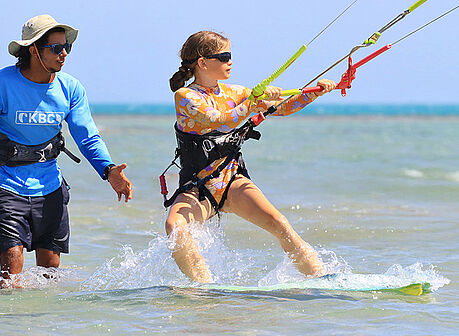
Now it gets serious: you put the board on your feet. The water start - getting up out of the water - is the hardest part for many people. With the right technique and a little patience you will soon celebrate your first successes. As soon as you are standing, you practise riding in one direction.
Day 4-5: Riding upwind and turning
In the advanced units you learn to ride upwind - that is, against the wind. Only once you master that can you kite independently, because otherwise the wind would keep drifting you downwind. You also practise turns and refine your technique.
What equipment do I need?
As a beginner you do not need to buy your own equipment - it is provided during the course. Even so, it helps to know what the basic kit consists of:
The kite: as a beginner you typically start with a tube kite (an inflatable kite) in a medium size, usually between 9 and 12 square metres. The kite size depends on your weight and on the wind conditions.
The bar: the control bar with its four lines (usually 20-24 metres long) connects you to the kite. You use the bar to steer the kite and regulate its power.
The harness: a waist or seat harness that the kite is hooked into. That way you do not have to hold the whole load with your arms.
The board: beginners mostly use twin-tip boards - symmetrical boards that can be ridden in both directions. They are forgiving and make getting started easier.
The wetsuit: between 3mm and 5mm thick depending on the water temperature. In warm spots such as Egypt a shorty or a lycra top is often enough.
Helmet and impact vest: obligatory for beginners and recommended for advanced riders too.
What does it cost to learn kitesurfing?
The cost of a kite course varies with the location and the course format. At KBC we offer several options:
Taster course (2-3 hours): from around 150 euros - ideal for getting a first feel for the sport.
Basic course (8-10 hours): around 400-600 euros - you learn all the basics up to riding on your own.
Complete package with accommodation: from around 800-1,500 euros for a week - the most effective option, because you practise every day.
Your own equipment can wait: a complete beginner set costs from around 1,000-1,500 euros second hand, while new equipment costs between 2,000 and 3,500 euros.
How long does it take until I can kite?
The honest answer: that is very individual. Most students can ride on their own after 10-15 hours of tuition and return safely to their starting point.
Factors that influence how fast you progress:
Previous experience: anyone who already wakeboards, snowboards or windsurfs often learns faster.
Physical fitness: a decent base level of fitness helps, but it is not a requirement. Kitesurfing is less exhausting than it looks - the power comes from the wind, not from your muscles.
Regular practice: someone who learns for a full week progresses faster than someone who practises once a month.
The conditions: steady wind and flat water speed up the learning process enormously.
The best spots for beginners
Not every spot is suitable for beginners. Ideal learning conditions are found at:
El Gouna, Egypt: a shallow lagoon, steady wind and warm water - perfect for beginners. One of the most popular KBC spots for beginner courses.
Dakhla, Morocco: a huge flat-water lagoon with a standing area and reliable wind. A paradise for every level.
Tarifa, Spain: the wind hotspot of Europe. Suitable for beginners at sheltered spots such as Los Lances or Valdevaqueros.
Brazil (Cumbuco, Parajuru): November to February offers steady wind and warm water. Wide sandy beaches and shallow areas.
Safety in kitesurfing
Kitesurfing is an extreme sport that can be dangerous if done wrong. With the right training and the right behaviour, however, you reduce the risks considerably:
Take professional lessons: teaching yourself to kitesurf is dangerous and inefficient.
Use the safety system: modern kites have a quick-release system that instantly depowers the kite. Practise using it until it becomes automatic.
Know your limits: only go on the water in conditions you can handle. Do not overestimate yourself.
Check the forecast: wind, currents and weather should be checked before every session.
Never kite alone: especially as a beginner it matters that someone on shore is keeping an eye on you.
Typical beginner mistakes
These are the mistakes we see in beginners again and again:
Wanting to get on the board too soon: patience with kite handling pays off. Anyone who has not mastered the kite will not be happy with the board.
Steering the kite too far back: at the back of the wind window the kite has maximum power - often far too much for a beginner.
Stiff arms: relaxed, slightly bent arms are essential. Tense up and you lose control.
Looking the wrong way: look where you are going, not at the kite or at your feet.
Too little theory: anyone who does not understand the wind window and wind theory will struggle.
CONCLUSION: YOUR PATH TO BECOMING A KITESURFER
Learning to kitesurf is one of the most rewarding decisions you can make as a watersports enthusiast. The initial investment in a good course pays off through fast progress and safe riding.
At KBC experienced VDWS instructors guide you along the way - from your first theory lesson to your first independent rides. With more than 25 years of experience and schools at the best spots worldwide, we offer you optimal conditions for your start.
Ready for your kite adventure? Then secure your place in the next beginner course now!